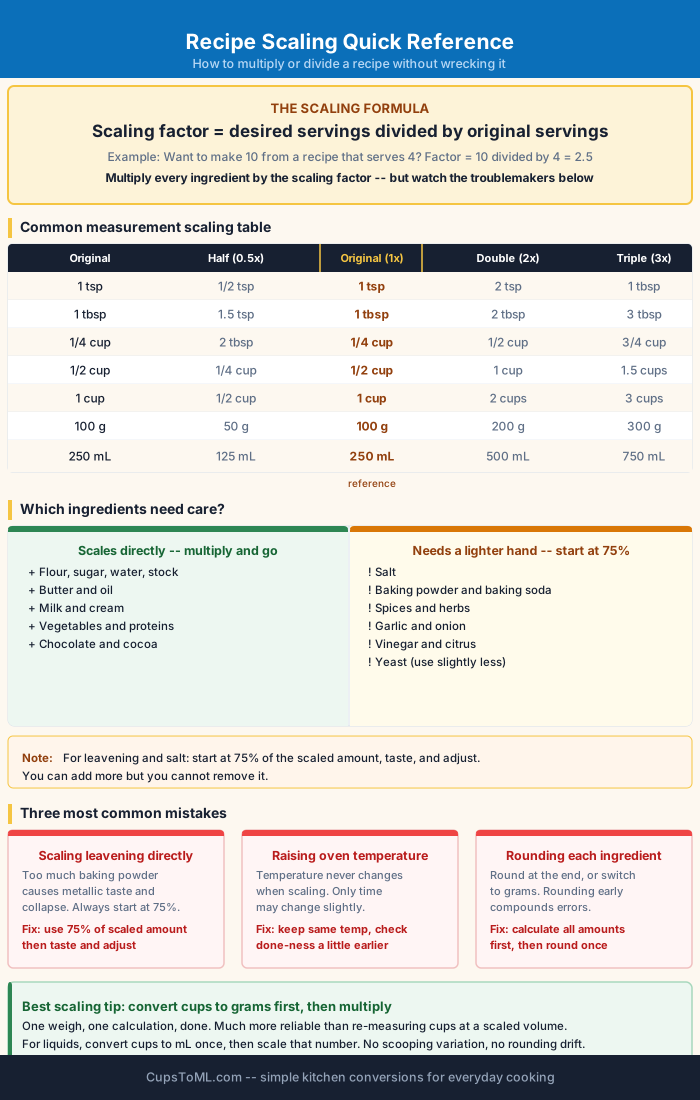
You decide to double a cake for a birthday, or cut a soup recipe in half so it stops taking over the fridge, and suddenly every ingredient becomes a little math problem. Most of the time scaling is straightforward. Multiply or divide and keep going. The trouble is that a few ingredients do not behave nicely when you do that, and those are exactly the ones that can wreck texture, rise, and balance. Start here for the main scaling method across the whole cluster: the core rule, the ingredients that scale cleanly, the ones that need restraint, and the next step when you are doubling, shrinking for 2, or troubleshooting a failed batch. For quick unit help while you work, use How Many mL Are in a Cup?, mL to Cups Converter, How do I convert Grams to Ounces?, or read Why Weight Beats Volume (Cups vs Grams).
Most ingredients scale directly. Salt, leavening, and spices need a lighter hand. Start at 75% and adjust from there.
Download this reference (SVG)
What is the basic rule for scaling a recipe?
The core method is simple: decide your scaling factor, then apply it to every ingredient. This is the parent guide for that method, so use it first before moving to the narrower pages about doubling, scaling for 2, or troubleshooting one specific texture problem. If you want to make three times the original recipe, multiply every ingredient by 3. If you want half the recipe, multiply by 0.5.
Your scaling factor is: desired servings ÷ original servings. For example, if a recipe serves 4 and you want 10, your factor is 10 ÷ 4 = 2.5. Multiply every ingredient by 2.5.
Where cooks run into trouble is forgetting that not every ingredient scales cleanly, and assuming baking time or pan behavior will stay identical. Doubling is where that mistake shows up fastest because the ingredient math may be right while the pan depth, mixing room, evaporation, and flavour balance all shift at the same time. The good news is that most of the recipe is easy. You really only need to watch a small group of troublemakers and treat doubling as both math and process control.
Which ingredients can you scale directly?
Most ingredients in a recipe scale directly. These are the easy ones, and it helps to see them in a cleaner layout than a long bullet list because most of them follow the same rule: multiply and move on.
Ingredient
How it scales
Practical note
Flour
Scales directly
2 cups becomes 4 cups when doubled
Sugar
Scales directly
Keeps sweetness and structure proportional
Water and stock
Scales directly
Liquids are usually safe to multiply
Butter and oil
Scales directly
Fat ratios are usually proportional
Eggs
Usually scale directly
Round carefully in very large or very small batches
Vegetables and proteins
Scale directly
Most savory recipes are forgiving here
Milk and cream
Scale directly
Best measured by mL when possible
Chocolate and cocoa
Scale directly
Works best when weighed
Which ingredients need a lighter touch?
A small category of ingredients do not scale linearly. These are the ones that make scaled recipes feel "off" even when your math was technically correct. They deserve more than a quick bullet point, because each one causes a different kind of problem.
Ingredient
Safer starting point
Why it needs care
Baking powder and baking soda
Start around 75% of the scaled amount
Too much can create metallic flavour and collapse
Salt
Start around 75%
Over-scales quickly and is hard to fix
Spices and herbs
Start around 50 to 75%
Strong flavours can dominate fast
Yeast
Use slightly less than full proportion
More yeast does not always mean better rise
Garlic and onion
Start around 75%
Flavour intensifies in large batches
Vinegar and citrus
Start around 75%
Acid can overpower when multiplied directly
Alcohol
Start around 75%
Reduction concentrates flavour as it cooks
The pattern is straightforward: anything that drives rise, saltiness, sharpness, or concentrated flavour deserves a slower hand than flour, stock, or butter.
Why is weight usually easier than volume when you scale?
When you scale a recipe, cups introduce two sources of error: the cup standard (Metric vs US) and measuring inconsistency (flour packs differently each scoop). Grams eliminate both problems.
If your original recipe uses cups, convert to grams first, scale the gram values, and measure with a kitchen scale. Your scaled result will be more consistent than re-measuring cups at a new volume.
For example: a recipe calls for 2 cups all-purpose flour (~240 g). You want to make 2.5×. Grams: 240 × 2.5 = 600 g — weigh it once, done. Cups: 2 × 2.5 = 5 cups — each scoop varies. See Why Weight Beats Volume (Cups vs Grams) for more.
For liquids, mL is equally reliable. Convert cups to mL once, scale the mL value, then measure with a jug. Use How Many mL Are in a Cup? or mL to Cups Converter to convert quickly.
What does recipe scaling look like in practice?
Examples get much easier to read when you can compare the factor, the easy ingredients, and the caution points side by side.
Start baking powder at 3.5 tsp and salt at 0.75 tsp; baking time may need 5 to 10 extra minutes
Vegetable soup
0.5×
Stock 3 cups, tomatoes 1 can, garlic 2 cloves
Start salt around 0.4 tsp and cumin around 0.75 tsp, then taste and adjust
Cookie recipe
1.5×
Most ingredients multiply directly
Keep baking soda slightly under full proportion and bake in batches instead of changing oven temperature
If your question is specifically about doubling, the cleanest workflow is to write the 2× batch out before you cook, mark the caution ingredients, and check the equipment before you mix. That keeps a doubled recipe from drifting just because the pot, pan, or reduction time changed while the ingredient math stayed the same.
When you double
What still scales cleanly
What to check before cooking
Soup or stew
Liquids, vegetables, proteins
Start salt and strong spices slightly under 2×, and make sure the pot still gives you room to stir
Pasta sauce
Tomatoes, oil, aromatics
Watch salt, chili, and reduction time so the finished sauce does not get heavier than expected
Cake or quick bread
Most base ingredients
Use caution with leavening, keep pan depth close to the original, and expect bake time to need checking rather than guessing
Bread dough
Flour, water, core ratio
Watch yeast, mixer capacity, and proofing space before you commit to one oversized batch
Casserole
Main ingredients
Check dish depth, center cook time, and browning so the middle does not lag behind the edges
That is the real scaling mindset: most of the recipe is easy, and a small set of ingredients needs judgment. Doubling usually succeeds when you check the cooking setup as carefully as the ingredient math.
What mistakes ruin scaled recipes fastest?
Most scaling mistakes are not math mistakes. They are process mistakes. You do the multiplication correctly, but the oven, pan, salt, or leavening behaves differently than expected.
Treating every doubled ingredient as exact — Flour or stock often scales cleanly, but salt, spices, leavening, yeast, and acid usually need a softer hand than straight 2× math.
Scaling leavening directly — This is the most common baking mistake. Too much baking powder gives metallic flavour and causes collapse.
Changing oven temperature — Do not increase oven temperature to speed up a larger batch. Use the original temperature and extend time slightly if needed.
Doubling ingredients without adjusting the equipment — A bigger batch often needs a wider pot, a larger bowl, or two pans instead of one. Equipment limits ruin plenty of doubled recipes before the math does.
Using a larger pan without adjusting time — A doubled recipe spread into the same pan size is thicker and will take longer to bake.
Scaling by memory — Write down your scaled amounts before you start. Recalculating mid-recipe while cooking leads to errors.
Rounding each ingredient separately — Round at the end, or use weight (grams) so rounding is less impactful.
Forgetting to scale mise en place — If the recipe says "pre-heat to 350°F," that does not change. But bowl sizes, mixer capacity, and pan sizes may need to change.
Overscaling salt and spices — Start at 75% and taste; you can always add more but can't remove it.
Quick scaling table
Use this table as a reference when scaling common recipe amounts. Apply your scaling factor to the original, then check the result against common measuring units.
Original
1/4×
1/2×
3/4×
1× (original)
1.5×
2×
3×
4×
1 tsp
1/4 tsp
1/2 tsp
3/4 tsp
1 tsp
1.5 tsp
2 tsp
1 tbsp
4 tsp
1 tbsp
3/4 tsp
1.5 tsp
2.25 tsp
1 tbsp
1.5 tbsp
2 tbsp
3 tbsp
4 tbsp
1/4 cup
1 tbsp
2 tbsp
3 tbsp
1/4 cup
6 tbsp
1/2 cup
3/4 cup
1 cup
1/2 cup
2 tbsp
1/4 cup
6 tbsp
1/2 cup
3/4 cup
1 cup
1.5 cups
2 cups
1 cup
1/4 cup
1/2 cup
3/4 cup
1 cup
1.5 cups
2 cups
3 cups
4 cups
100 g
25 g
50 g
75 g
100 g
150 g
200 g
300 g
400 g
250 mL
62.5 mL
125 mL
187.5 mL
250 mL
375 mL
500 mL
750 mL
1000 mL
FAQs
Does baking time change when I scale a recipe?
Usually not for the same pan. Baking time depends on the thickness of the batter or dough, not the total volume. If you use the same pan and the recipe is thicker due to more volume, add 5–10 minutes and check with a skewer.
Should I change oven temperature when scaling?
No. Temperature stays the same regardless of the scaling factor.
Can I scale a bread recipe?
Yes, but yeast does not scale linearly. Use slightly less than the proportional amount of yeast (about 75–80% of the scaled quantity) and allow extra time for fermentation at larger volumes.
Why does my doubled cake collapse?
Most likely too much leavening. Scale baking powder and baking soda to about 75% of the doubled amount and test again.
Is it better to use grams when scaling?
Yes. Weight (grams) is more consistent than volume (cups) for scaling. Convert cups to grams once, then multiply — see Why Weight Beats Volume (Cups vs Grams) for detail.
How do I scale a recipe for a different pan size?
Calculate the area of both pans (length × width for rectangular, πr² for round). Divide the new pan area by the original pan area to get your scaling factor for batter volume.
What is the most common scaling mistake?
Scaling salt and leavening directly without reduction. Always start at 75% for salt, spices, baking powder, and baking soda, then taste and adjust.