Is it wrong to use US cups for a metric recipe?
Not wrong, but totals will shift more as the recipe size increases.
You find two nearly identical recipes for the same soup, cake, or smoothie, but one comes from a US source and the other comes from a metric-first kitchen. Both say "cups," yet the numbers do not quite line up. This page is the worked-example support piece for that exact moment, not the main explainer. If you need the main explanation first, start with Metric vs US Cup: Why Results Differ. Then come back here for the real kitchen examples that show how the totals shift before you start measuring.
A recipe written in one cup standard and measured with another does not fail automatically, but the totals do shift. The bigger the recipe, the easier that shift is to notice. In a single drink, it may be minor. In a soup pot, batch sauce, or cake batter built around several cups, the gap becomes much easier to feel.
This matters most in recipes with repeated cup measurements: soups, stocks, smoothie bases, drink prep, muffin batter, pancake batter, and flour-heavy baking. The difference between a Metric cup and a US cup is only about 13.4 mL each time, but repeated small changes are exactly how a recipe starts tasting or behaving differently from what you expected.
That is why practical examples help more than theory here. Seeing what happens at 2 cups, 4 cups, or 8 cups gives you a much clearer sense of when to shrug and when to stop and switch standards.
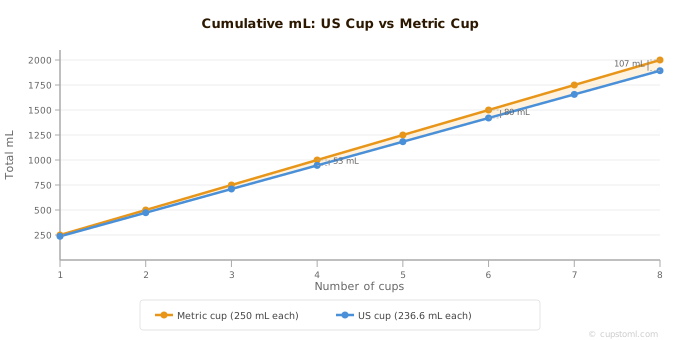
This section works best as a quick-reference table. If you are in the middle of cooking, scan down the left column, find the amount closest to your recipe, and compare the totals before you measure.
| Recipe amount | Metric total | US total | Where it shows up |
|---|---|---|---|
| 1 cup milk | 250 mL | ~236.6 mL | Small batter or one smoothie |
| 2 cups water or broth | 500 mL | ~473 mL | Quick soup or rice base |
| 3 cups stock | 750 mL | ~710 mL | Medium soup pot |
| 4 cups stock | 1 L | ~946 mL | Batch soup or stew |
| 5 cups sauce base | 1250 mL | ~1183 mL | Meal-prep sauce |
| 6 cups soup base | 1500 mL | ~1419 mL | Larger family batch |
| 8 cups batch total | 2000 mL | ~1893 mL | Big soup, chili, or drink prep |
| 10 cups beverage prep | 2500 mL | ~2366 mL | Punch, tea, or event batch |
| 1/2 cup oil | 125 mL | ~118 mL | Cake or muffin batter |
| 1/3 cup sugar | ~83 mL | ~79 mL | Baking or sweet sauces |
| 1/4 cup syrup | ~62.5 mL | ~59 mL | Dressings, marinades, glaze |
The repeated pattern is the important part: the farther down that table you go, the more the totals drift apart. That is why bigger recipes deserve a quick standard check before you start.
A one-cup mismatch usually feels small. You might notice it in a drink ratio or a delicate batter, but many everyday recipes can absorb it. Once you get into 4 cups of broth, 6 cups of soup base, or 8 cups of batch prep, you are no longer talking about a tiny splash. You are changing the total liquid enough to affect concentration, yield, and in some recipes texture.
That is especially true if more than one ingredient is shifting. A recipe that uses the wrong standard for both flour and milk, or broth and cream, can end up off in more than one direction at once. This is why a dish can feel mysteriously thicker, thinner, sweeter, or looser than the recipe promised even when you measured carefully.
The easiest fix is not to keep converting every line separately in your head. Pick the right standard once, convert once if needed, and let the whole recipe follow that decision.
Start with the recipe source. If it comes from a US cookbook, US blog, or American packaged-food source, use US cups unless the recipe gives metric values directly. If it comes from a Canadian or other metric-first source, there is a good chance the recipe expects a Metric cup.
If the recipe gives mL, trust the mL and ignore cup assumptions. That is usually the cleanest path. For fast conversion checks while you compare totals, open cups to mL, use How Many Ounces Are in a Cup? when needed, and keep the Kitchen Volume hub handy.
For baking, prefer grams whenever they are available. Weight is more consistent than cups, and it avoids both the cup-standard issue and the packing issue that comes with dry ingredients.
If you are working with a liquid-heavy recipe, measuring by mL is usually the simplest answer. If you are baking, grams are often the better move because they solve more than one problem at once. They remove cup-standard confusion and help you avoid the variation that comes from packing flour, sugar, cocoa, and other dry ingredients differently each time.
If you want the fuller baking argument, the guide on why weight beats volume walks through the dry-ingredient side of the issue in more detail. For choosing between dry and liquid cups, the related guide on dry vs liquid measuring cups is the practical companion page.
Not wrong, but totals will shift more as the recipe size increases.
That is the Metric cup standard used across many metric-first recipe sources.
Convert to mL and measure with a metric jug.
Usually less, but it can when you’re chasing consistent ratios.
Yes for baking whenever weights are available.
Convert one unit once, then multiply from that total to reduce repeated rounding drift.