Does packed brown sugar really mean firmly pressed in?
Yes. It means pressing enough to remove air gaps so the amount is consistent.
A recipe says to use packed brown sugar, and suddenly a basic ingredient sounds more technical than it should. Do you really need to press it down? How firmly? And what happens if you just scoop it loosely and move on? Brown sugar is one of those ingredients where the measuring style is part of the amount, not just the technique. This guide explains what packed means, why recipes specify it, and when it actually matters.
Packed brown sugar means pressing the sugar into a dry measuring cup so the air gaps are reduced and the cup holds a predictable amount. When you turn the cup out, the sugar should usually keep the shape of the cup instead of falling out loosely.
Recipes call this out because brown sugar is clumpy, moist, and uneven by nature. A loosely filled cup can contain a lot less sugar than a packed one. That changes sweetness, moisture, browning, and chew in baked goods.
So in this case, “packed” is not just a preference. It is part of the measurement itself.
Granulated white sugar flows more evenly and leaves fewer air gaps, so a cup of white sugar is fairly straightforward. Brown sugar is different because the molasses makes it cling together in soft clumps. If you spoon it loosely, those clumps create empty spaces in the cup.
| Ingredient | How it behaves in a cup | What recipes usually assume |
|---|---|---|
| Granulated sugar | Settles evenly | Level cup is usually enough |
| Brown sugar, loose | Leaves air gaps and uneven density | Often too light for baking recipes |
| Brown sugar, packed | More consistent and dense | Common baking expectation |
That is why recipes usually specify packed brown sugar but not packed white sugar. The ingredients do not behave the same way in the cup.
If you measure brown sugar loosely when the recipe expected packed, you may use less sugar than intended. In cookies, that can reduce chew and leave the texture drier. In quick breads and muffins, it can change both sweetness and moisture. In sauces or glazes, the result may taste flatter or thinner than expected.
This is one reason people think a recipe is inconsistent when the real issue is just one measuring habit. A cup of packed brown sugar and a loose cup do not act like the same ingredient amount, even though the label says “1 cup” either way.
For baking especially, packed means packed unless the recipe clearly says otherwise.
You do not need to crush it into a brick. The goal is firm packing, not excessive force. Think consistent pressure, not maximum pressure.
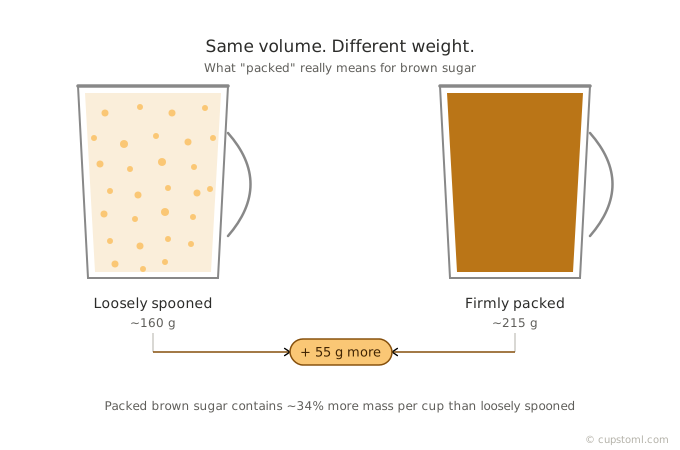
In cookies, packed brown sugar helps create the chew and moisture many recipes expect. If you measure loosely instead, the dough may still bake, but the cookies can come out a little drier and less rich than intended.
In quick breads and muffins, the change may feel smaller at first, but it still affects browning and tenderness. Brown sugar is doing more than sweetening. It is also contributing moisture and texture.
This is why packed brown sugar is one of those instructions that looks fussy but is actually useful. It helps the recipe mean the same thing from one kitchen to another.
If the recipe gives grams, weigh the brown sugar and move on. That is the easiest way to avoid debating how firm “packed” should feel. Weight removes the judgment call and gives you the amount directly.
This is especially helpful in recipes you make repeatedly, like cookies, banana bread, crumb toppings, and holiday baking. Once a recipe becomes part of your routine, the simplest path is usually the one that gives you the same result every time.
So the kitchen-friendly rule is this: if the recipe only gives cups, pack the brown sugar. If it gives grams, use the grams and skip the measuring-cup drama.
Yes. It means pressing enough to remove air gaps so the amount is consistent.
Many baking recipes still assume packed, but it is best when the recipe states it clearly.
Yes, and that is the cleanest option if the recipe gives grams.
That is the easiest visual sign that it was packed consistently.
No. It also affects moisture, browning, and texture in baking.